
Too Long? Read This First
- Conversational AI is the technology behind chatbots, voice agents, and AI assistants that understand human language.
- It has moved from a niche tool to core customer experience infrastructure between 2024 and 2026.
- Comes in four forms: text chatbots, voice agents, agent copilots, and fully autonomous agentic AI.
- Delivers measurable ROI across marketing, sales, and support functions.
- Works best when grounded in clean data with clear escalation rules to humans.
- Still has real limits around emotional complexity, ambiguous queries, and system integrations
You have already used conversational AI today. The bot that tracked your Amazon order. The voice that picked up when you called your bank. The WhatsApp assistant that confirmed your appointment. These are all part of conversational AI.
Conversational AI moved from a niche customer service tool to core CX infrastructure between 2024 and 2026. According to Gartner, contact centers will save $80 billion in agent labor costs by the end of 2026
This guide is the no-padding version: what conversational AI actually is, the four technologies that make it work, the four real types you will come across in 2026, and where it’s actively driving revenue right now.
What is Conversational AI?
AI conversational chatbots are advanced applications that leverage Natural Language Processing (NLP), Machine Learning (ML), and large language models to understand context, sentiment, and user intent, enabling human-like interactions.
The clearest way to understand it is by contrast:
- A rule-based chatbot matches keywords. Type “refund,” and it pastes the refund policy. Misspell it as “refnd,” and it breaks.
- Conversational AI understands the intent behind “I think I was charged twice last Tuesday” — even though the word “refund” never appears.
That gap is the entire reason 91% of businesses with 50+ employees now use AI chatbots somewhere in the customer journey (Marketing LTB, 2026).
Conversational AI vs Chatbot vs Generative AI vs Agentic AI
These four terms are used interchangeably and shouldn’t be. Here’s the breakdown that matters in 2026:
Rule-based chatbot | Conversational AI | Generative AI | Agentic AI | |
|---|---|---|---|---|
Core capability | Keyword/script matching | Understands intent and context | Generates new content from prompts | Plans and executes multi-step actions |
Memory | None | Multi-turn within a session | Limited to the context window | Persistent across conversations |
Example | “Press 1 for sales” IVR | A WhatsApp support bot that resolves order queries | ChatGPT is writing an email | An AI agent that books a meeting, sends the invite, and updates your CRM |
Best for | Simple FAQs | Customer support, lead qualification | Content creation, summarization | Sales workflows, end-to-end task automation |
An AI sales agent on WhatsApp uses conversational AI for the dialogue, generative AI for the responses, and agentic AI to actually book the meeting and update HubSpot – all in one chat thread.
The 4 Types of Conversational AI in 2026
1. Text-based chat assistants. Live on WhatsApp, web chat, Instagram DMs, and SMS. This is the largest segment – AI chatbots account for roughly 62% of the conversational AI market. Use cases: support deflection, lead qualification, abandoned cart recovery.
2. Voice AI agents. The fastest-growing segment. They handle inbound calls, outbound qualification, and WhatsApp voice messages. US voice assistant users are projected to hit 157.1 million in 2026 .
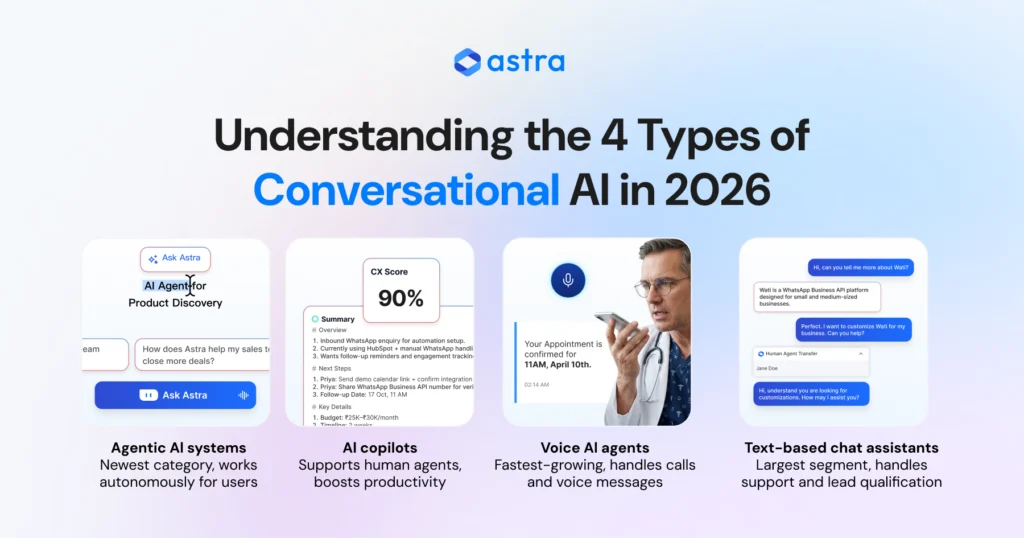
3. AI copilots for human agents. Instead of replacing the agent, copilots sit beside them- summarizing long chat histories, suggesting replies, translating in real time, and scoring conversation quality. This category exploded in 2025 because it offers the productivity gains of AI without the customer trust trade-off of full automation.
4. Agentic AI systems. The newest category. These don’t just talk – they work for you. They qualify a lead, check calendar availability, book a meeting, send a confirmation, and log the deal in your CRM, all autonomously. Gartner projects agentic AI as the segment with the steepest growth curve through 2032.
What conversational AI actually delivers (with real numbers)
Here’s what the 2026 data actually shows.
- Cost per interaction drops from ~$6 (human agent) to ~$0.50 (AI chatbot). A 91% reduction (Dante AI, 2026 industry analysis).
- Voice AI costs roughly $0.40 per call, compared with $7–$12 per call for human agents.
- AI agents deflect over 45% of incoming customer queries, with retail and travel industries pushing past 50%.
- Companies report a $3.50 return for every $1 invested in AI customer service, with an average first-year ROI of 340% (Dante AI, 2026).
- Click-to-WhatsApp ads using conversational AI see up to 85% higher response rates versus standard ad funnels (Wati customer data).
- Customer satisfaction lift is real but conditional. Consumers prefer instant 24/7 AI service over waiting for a human, but only when the AI actually resolves the issue
Conversational AI works when it’s grounded in your actual data and given clear handoff rules. It fails when it’s a generic bot bolted onto a website with no knowledge base.
5 Conversational AI Examples Driving Real Business Outcomes in 2026
1. Product recommendation assistant: drove a higher lift in conversion rates after deploying AI-assisted product recommendations (industry case study).
2. WhatsApp lead qualification on click-to-chat ads: Businesses running Meta ads that route into a conversational AI flow on WhatsApp (instead of a static landing page) consistently see 3–5x higher reply rates because the conversation starts immediately and qualifies intent in the first 30 seconds.
3. E-commerce abandoned cart recovery: AI agents that re-engage customers 24 hours after cart abandonment are seeing an increase in repeat purchases through automated post-sale messaging.
4. AI Support Agents grounded in a knowledge base: Platforms like Wati’s AI Support Agent train on your help docs and FAQs to resolve up to 60% of routine support queries instantly, escalating only the complex cases to humans with full context preserved.
5. Voice cloning + AI agents on WhatsApp: the newest category. A business records a short script, the AI clones the voice and personality, and the AI twin handles inbound calls and qualifies leads in 30+ languages. Here is how conversational AI fits inside marketing, sales, and support.
- Marketing uses it to convert ad clicks into conversations, run WhatsApp broadcast campaigns, and re-engage cold leads.
- Sales uses inbound intelligence agents to instantly qualify leads, score intent, and route only sales-ready leads to reps.
- Support uses AI agents for tier-1 deflection, copilots for agent productivity, and quality scoring to monitor every conversation for CX risk.
Wati’s Conversational Intelligence Layer, Copilot, AI Agents, and Bring Your Own AI (BYOA), is purpose-built for this lifecycle approach: one platform that handles the full marketing-to-support flow on WhatsApp and connected channels rather than three separate point tools.
How to Actually Start with Conversational AI (Without a 12-Month Project)
The single biggest mistake businesses make is treating conversational AI as a transformation project. It’s not. Here’s the version that works.
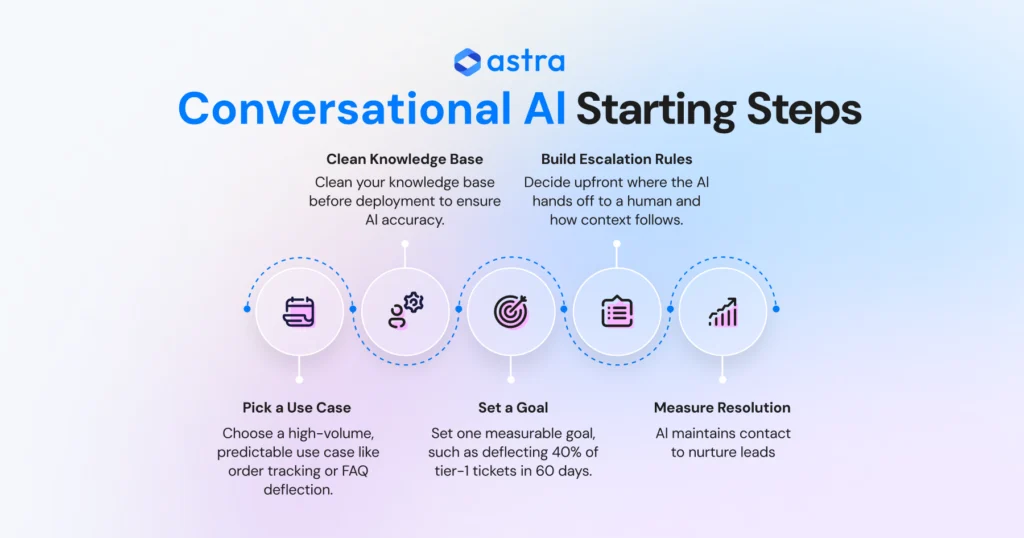
- Pick one high-volume, predictable use case. Order tracking, FAQ deflection, appointment booking, and lead qualification. Don’t start with your hardest support tier.
- Clean your knowledge base before deployment. AI is only as smart as the docs you feed it. An afternoon spent fixing your help center delivers more than another month of “AI strategy.”
- Set one measurable goal. “Deflect 40% of tier-1 tickets in 60 days” beats “improve customer experience.”
- Build clear escalation rules. Decide upfront where the AI hands off to a human and how full context follows the conversation.
- Measure resolution, not just deflection. A bot that closes 80% of tickets at the cost of customer satisfaction is a worse outcome than a bot that closes 50% with high CSAT.
For a deeper walkthrough of building this on WhatsApp specifically, see How to Set Up a WhatsApp AI Chatbot with Wati and the end-to-end WhatsApp chatbot guide for 2026.
The Honest Limits of Conversational AI in 2026
A few things conversational AI still doesn’t do well, even in 2026:
- Genuinely novel emotional situations. It can recognize sentiment, but it can’t replace human judgment in escalations involving grief, legal-weight complaints, or VIP recovery.
- Out-of-domain questions. A banking AI grounded solely in banking data will hallucinate or refuse to answer tangential questions.
- Reasoning under ambiguity without data. If the AI doesn’t have access to the right system (CRM, order DB, calendar), it can’t answer authoritatively. Integration depth matters more than model size for most business use cases.
Try the Best Conversational AI Platform
The platforms winning in 2026 aren’t the ones with the smartest standalone AI – they’re the ones with the deepest integrations and the cleanest handoff to humans. Talk to our expert to understand which fits best for your business.
FAQs
Is conversational AI the same as a chatbot?
No. A traditional chatbot follows scripts and matches keywords. Conversational AI understands intent, maintains context across multiple turns, and dynamically adapts responses. Every conversational AI system is a chatbot in form, but not every chatbot is conversational AI.
Is ChatGPT a conversational AI?
ChatGPT is a generative AI model that powers conversational AI experiences. Conversational AI is the broader category – it includes the dialogue management, intent recognition, and integration layers that turn a raw LLM into a usable customer-facing system.
What
’
s the difference between conversational AI and agentic AI?
Conversational AI talks. Agentic AI acts. A conversational AI bot answers, “What’s your refund policy?” An agentic AI agent processes the refund, updates the order system, and sends the confirmation autonomously.
How accurate is conversational AI in 2026?
Resolution rates of 60–80% on routine queries are standard for well-implemented systems grounded in a clean knowledge base. Accuracy drops sharply when the AI is asked questions outside its training scope, which is why retrieval-augmented generation (RAG) and tight integrations are now table stakes.
Frequently asked questions
Is conversational AI the same as a chatbot?
No. A traditional chatbot follows scripts and matches keywords. Conversational AI understands intent, maintains context across multiple turns, and dynamically adapts responses. Every conversational AI system is a chatbot in form, but not every chatbot is conversational AI.
Is ChatGPT a conversational AI?
ChatGPT is a generative AI model that powers conversational AI experiences. Conversational AI is the broader category - it includes the dialogue management, intent recognition, and integration layers that turn a raw LLM into a usable customer-facing system.
What's the difference between conversational AI and agentic AI?
Conversational AI talks. Agentic AI acts. A conversational AI bot answers, "What's your refund policy?" An agentic AI agent processes the refund, updates the order system, and sends the confirmation autonomously.
How accurate is conversational AI in 2026?
Resolution rates of 60–80% on routine queries are standard for well-implemented systems grounded in a clean knowledge base. Accuracy drops sharply when the AI is asked questions outside its training scope, which is why retrieval-augmented generation (RAG) and tight integrations are now table stakes.
Related posts
- AI Lead Qualification is Changing How Sales Teams Build Pipeline in 2026
Intent goes cold fast. See how AI lead qualification engages every lead instantly, scores them in real time, and routes only the best ones to your team automatically.
- AI Agent vs. Chatbot: What’s the Real Difference in 2026?
AI agent vs chatbot guide for 2026. Discover the key differences, where to use each, and how to integrate them with customer service workflows to drive sales.
- Conversational AI Chatbot for Product Search: Why Shoppers are Done With Filters
Conversational AI removes the friction of traditional filters by letting shoppers describe what they want in natural language. Instead of typing keywords and adjusting endless settings, users get guidance that understands intent, remembers context, and adapts results in real time. This turns product discovery into a fluid, conversational experience that feels more like talking to a knowledgeable store associate and less like fighting a search bar.
- AI Customer Support in 2026: What It is, How It Works, and Why Smart Teams are Quietly Switching Over
Learn how AI in customer support manages ticket escalations, automates ticket tagging and routing, and improves customer satisfaction. See how Astra does it.