
Too Long? Read This First
- Traditional filters were built around catalog logic, not how real shoppers actually think - and it's costing stores conversions every single day.
- A conversational AI chatbot reads intent, asks the right follow-ups, and guides shoppers to the right product through natural dialogue.
- The real engine: NLP, semantic search, multi-turn memory, and real-time behavioral signals working together.
- Mobile is where the gap is widest. 80% of retail traffic is now mobile, but the UX is still designed for desktop filter sidebars.
- Before you buy any tool, test it on vague, real-world queries from your own shoppers. Most "conversational" tools are just keyword search in a chat skin.
- Intent-based shopping is already the norm in messaging apps. The stores adopting it now will be ahead of an expectation that's about to become the baseline.
A shopper lands on your store looking for “something warm for a weekend hiking trip, nothing too bulky.”
They type it into your search bar. Zero results.
They try “jacket.” They get 847 options and a sidebar of filters that don’t match how they actually think.
So they leave.
It’s the default experience on most e-commerce stores and exactly the problem a conversational AI chatbot is built to solve, not by being a smarter search bar, but by replacing the search bar entirely with dialogue.
Here’s why filters are quietly killing conversions, what conversational AI product search actually is, and how to tell the real thing from the marketing version.
How Traditional Product Search Quietly Kills Conversion
Most e-commerce stores treat search as a solved problem. There is a search bar at the top, filters on the left, and a results page that updates on click.
It works. Technically.
But “technically working” and “actually helping shoppers buy” are two different things.
Baymard Institute’s research on the 8 most common search query types found that 41% of sites fail to support the queries shoppers actually use. These aren’t small indie stores – they’re established retailers with dedicated UX teams.
The core issue is structural.
Keyword search runs on exact matching. When a shopper types “red evening dress for a wedding under $200,” the system scans for those words. If your catalog says “crimson formal gown,” the result is zero matches. The shopper assumes you don’t carry it. They leave even though you do.
Filters compound the problem.
They ask shoppers to self-sort by sleeve length, fabric weight, or collar type before they’ve seen a single product. That’s not how people decide. That’s how spreadsheets are organized.
Then there’s mobile. According to Statista’s 2025 e-commerce data, smartphones now account for nearly 80% of all retail site visits worldwide. And Baymard’s 2025 Mobile UX Trends report found that 81% of leading mobile ecommerce sites score “mediocre” or worse on overall UX. Filter-heavy interfaces were built for desktop. On a phone, they’re the first reason shoppers bounce.
This results in a discovery experience that fails the majority of shoppers, not because the product is not there, but because the search couldn’t understand them.
What is a Conversational AI Chatbot for Product Search?
The term gets stretched to mean anything. So here’s a clean definition.
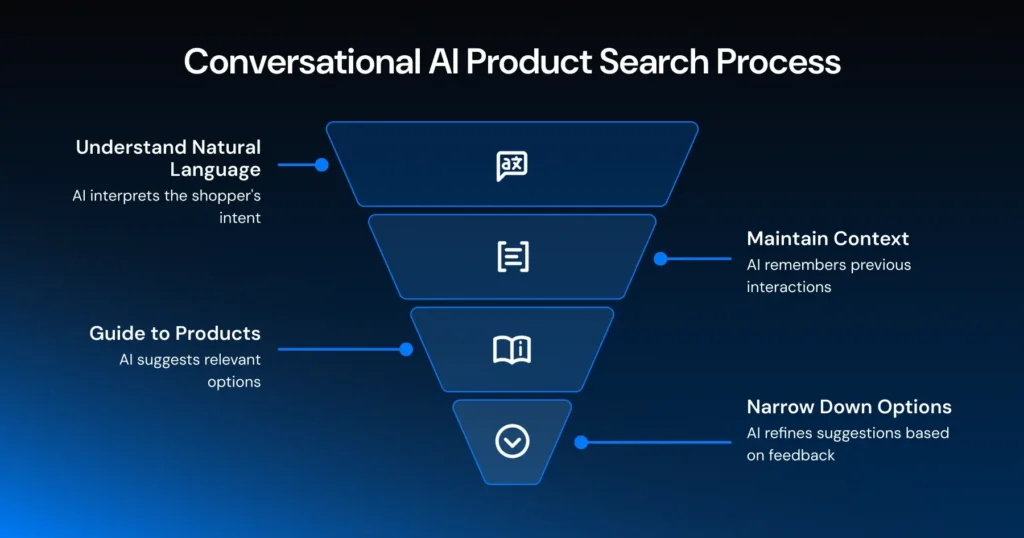
A conversational AI chatbot for product search is a system that understands natural language, maintains context across a conversation, and uses that context to guide a shopper to the right product, much as a skilled in-store associate works.
Here’s the difference in practice.
- A shopper visits a footwear store and types: “I need something comfortable for a week of walking around Europe, nothing too sporty.”
- A keyword search returns zero results or a wall of sneakers. A conversational AI chatbot reads the intent: comfort, durability, all-day wear, and versatile styling.
It responds with two or three relevant options and asks: “What’s your budget, and do you prefer a lace-up or slip-on?” The shopper answers.
The AI narrows further. Within a few exchanges, they have found what they need without a filter being touched.
The system is doing the filtering instead of the shopper.
Conversational AI vs a Regular Chatbot
This is where a lot of people get tripped up.
Rule-based chatbots follow rigid decision trees. They handle only the queries explicitly scripted for them. Ask anything slightly off-script, and they fall over.
Conversational AI is different in three important ways:
- It interprets meaning, not exact words.
- It remembers context across the whole conversation, not just the last message.
- It adapts with every response instead of treating each query as a fresh start.
For e-commerce, the implication is huge: shoppers no longer need to know your catalog’s language to find what they want. They just need to describe what they need.
What’s Actually Happening Under the Hood
You don’t need to understand the tech to use it. But knowing what’s going on helps you spot the real thing vs. a fancier search bar with a chat interface bolted on.
Four pieces matter.
1. Natural Language Processing (NLP)
NLP enables the system to read intent rather than scanning for keywords.
When a shopper types “something cozy for a Netflix night,” NLP breaks that into signals, casual, comfortable, indoor, relaxed, and maps them to product attributes across your catalog. Even if none of your descriptions use the word “cozy.”
2. Semantic Search
Where keyword search looks for exact matches, semantic search looks for meaning. It knows that “sofa” and “couch” are the same thing.
That “running shoes for bad knees” implies cushioning and support. That “office-appropriate” means something different in a fashion brand vs. a workwear brand.
This is what lets the system surface relevant products even when the shopper’s language doesn’t match the catalog’s language.
3. Multi-Turn Memory
This is what makes the experience feel like a real conversation instead of a one-shot query. The system remembers what was said earlier.
If a shopper says, “I liked the second one, but it’s a bit pricey,” the AI knows which product, understands the constraint, and adjusts. No starting over.
4. Real-Time Behavioral Signals
Beyond what shoppers say, conversational AI reads what they do. Pages visited, time spent on a product, items added to, and removed from the cart.
These signals feed the conversation and help the system infer intent even when the shopper hasn’t fully articulated it.
The most advanced setups carry context across channels, too.
A shopper can start on your website, continue on WhatsApp during their commute, and finish on mobile, without repeating themselves.
For carts that don’t convert in one session, this continuity is often what closes the gap. (Worth seeing how this works in practice on WhatsApp specifically, since most mobile shoppers already live there.)
What This Looks Like Across Three Different Stores
Three quick scenarios. Same technology. Very different shopping problems.
Fashion: Shopping by Occasion, Not Category
A shopper needs something for a friend’s beach wedding. They type: “I need an outfit for a beach wedding, not too formal, budget around $150.”
A standard search returns formal gowns or beachwear, neither right. A conversational AI reads occasion, tone, and budget.
It surfaces three curated options: flowy midi dresses in breathable fabrics, and asks: “Do you prefer a dress or a two-piece? And what’s your usual size?” Two exchanges later, the shopper has a recommendation with a note on why it fits the brief.
No dead ends. Found in under two minutes.
Electronics: Translating Goals Into Specs
A shopper needs a laptop but doesn’t know what specs they need. They type: “I work from home and do a lot of video calls. I need something reliable that won’t die on me mid-meeting.”
Instead of returning a price-sorted list, the AI translates that into requirements: a strong battery, a good built-in camera, and reliable performance for video conferencing.
It surfaces two or three options, each with plain-English reasoning. The shopper didn’t need to know what RAM does. They just described their day.
Home Decor: Narrowing a Huge Catalog Through Dialogue
A shopper is redecorating but doesn’t know where to start. They type: “I’m looking for a sofa, something modern but cozy, not too big.”
The catalog has 400 sofas. A filter search would require knowing dimensions, materials, and style categories first.
The conversational AI asks instead: “What’s the rough size of your space? And are you drawn more to neutral tones or something with a bit of color?” Two questions in, the catalog is down to eight. Three exchanges later, one is in the cart.
Why Conversational AI is Built for Mobile Shoppers
The mismatch between mobile traffic and mobile UX is the biggest unforced error in e-commerce right now.
80% of retail visits are mobile. But the product discovery experience on most mobile stores is still the same filter-heavy, multi-tap navigation designed for a desktop browser with a large screen and a precise mouse cursor.
You feel it the moment you try to use it. Filter sidebars collapse into hidden menus. Dropdowns are hard to tap accurately. Long results pages mean endless scrolling. Typing a precise keyword on a small keyboard is a friction point before the shopping has even started.
A conversational AI chatbot removes most of that by design.
- It meets shoppers where they already are. Mobile shoppers live in chat interfaces, WhatsApp, iMessage, and every messaging app on their phone. A conversational search experience feels native on mobile in a way a checkbox sidebar never will.
- It replaces filtering with messaging. Instead of working through four filter categories to narrow a catalog, two or three questions can do the same. Faster. Less frustrating. Far better suited to a small screen.
- It matches mobile behavior. Mobile sessions are shorter. Tolerance for friction is lower. Shoppers either find what they’re looking for quickly or they leave. Conversational AI is built for exactly that pattern.
- It opens the door to voice. On mobile, typing is the bottleneck. A conversational chatbot that accepts voice input removes it entirely.
For stores where mobile traffic is growing but mobile conversion is still trailing desktop, this is often where the leak is.
How to Evaluate a Conversational AI Chatbot for Your Store
Not every tool with “AI” in the name is conversational AI. Some are genuinely intelligent. Many are dressed-up filter systems with a chat skin.
Use this checklist before you sign anything.
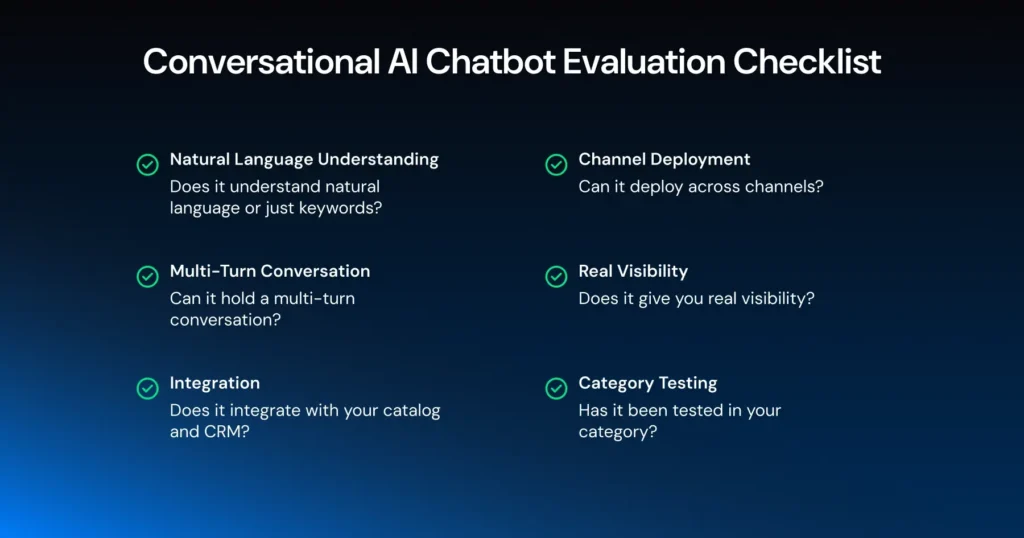
Does it understand natural language or just keywords? Ask the vendor to run real-world queries from your shoppers – vague, intent-driven phrases like “something for a first-time runner” or “a gift for someone who has everything.” If results look like a keyword search in disguise, that’s exactly what it is.
Can it hold a multi-turn conversation? A single-query system isn’t conversational AI. Test mid-session context. If a shopper says, “Show me something cheaper,” does the AI know what they were looking at? If not, it’s not built for real dialogue.
Does it integrate with your catalog and CRM? Conversational search is only as good as the data it can reach. Confirm clean integration with your product feed, inventory, and customer data.
Can it deploy across channels? A solution that only works on your website is leaving opportunity on the table. Look for one that extends the same experience across web, mobile, and messaging platforms like WhatsApp.
Does it give you real visibility? You should see what shoppers are searching for, where conversations drop off, and how AI-driven sessions compare to standard search in terms of conversion. If the vendor can’t show this clearly, keep looking.
Has it been tested in your category? Fashion and consumer electronics have very different search challenges. Make sure the tool has been tested on catalogs and query types similar to yours, not just generic demos.
The Filter Era is Ending. The Question is How Fast.
Traditional product search was built for a different kind of shopper. One who arrives knowing exactly what they want, speaks your catalog’s language, and has the patience to work through twelve filters on a five-inch screen.
That shopper is getting rarer by the quarter.
The shift toward natural-language, intent-based search is already happening. Shoppers describe what they need in plain terms and expect stores to keep up. The ones that do will convert more, lose fewer shoppers to frustration, and build the kind of discovery experience that brings people back.
If you’re ready to move past filters and give your shoppers a smarter way to find what they want, Astra – Wati’s AI agent is built for exactly this. Trained on your catalog. Deployable across the web and WhatsApp. Designed to turn browsing into buying.
Frequently Asked Questions
1. What is a conversational AI chatbot for product search?
A conversational AI chatbot for product search lets shoppers find products by describing what they need in natural language, instead of typing exact keywords or clicking through filters. The system reads intent, asks follow-up questions, and surfaces relevant results through dialogue.
2. How is a conversational AI chatbot different from a regular site search?
Traditional site search matches keywords to product listings. A conversational AI chatbot understands the meaning behind a query, holds context across the conversation, and guides shoppers to the right product the way a sales associate would.
3. Do I need a large product catalog for this to work?
Not really. Conversational AI adds value wherever shoppers need help figuring out what they want. Stores with complex, high-consideration products often see strong results regardless of catalog size.
4. Does implementing this mean replacing our existing search?
No. Most stores run both in parallel. Shoppers who know exactly what they want still use direct search. Conversational AI serves those who need guidance.
5. How do I know if a conversational AI solution is actually intelligent?
Test it with vague, real-world queries from your shoppers. A genuinely intelligent system understands intent and asks clarifying questions. One that returns keyword matches in a chat window is not real conversational AI.
6. Can a conversational AI chatbot work on WhatsApp?
Yes. The most useful implementations carry conversations across the web and WhatsApp without losing context. For most e-commerce brands, this is where mobile conversion finally catches up to desktop.
Frequently asked questions
1. What is a conversational AI chatbot for product search?
A conversational AI chatbot for product search lets shoppers find products by describing what they need in natural language, instead of typing exact keywords or clicking through filters. The system reads intent, asks follow-up questions, and surfaces relevant results through dialogue.
2. How is a conversational AI chatbot different from a regular site search?
Traditional site search matches keywords to product listings. A conversational AI chatbot understands the meaning behind a query, holds context across the conversation, and guides shoppers to the right product the way a sales associate would.
3. Do I need a large product catalog for this to work?
Not really. Conversational AI adds value wherever shoppers need help figuring out what they want. Stores with complex, high-consideration products often see strong results regardless of catalog size.
4. Does implementing this mean replacing our existing search?
No. Most stores run both in parallel. Shoppers who know exactly what they want still use direct search. Conversational AI serves those who need guidance.
5. How do I know if a conversational AI solution is actually intelligent?
Test it with vague, real-world queries from your shoppers. A genuinely intelligent system understands intent and asks clarifying questions. One that returns keyword matches in a chat window is not real conversational AI.
6. Can a conversational AI chatbot work on WhatsApp?
Yes. The most useful implementations carry conversations across the web and WhatsApp without losing context. For most e-commerce brands, this is where mobile conversion finally catches up to desktop.
Related posts
- AI Lead Qualification is Changing How Sales Teams Build Pipeline in 2026
Intent goes cold fast. See how AI lead qualification engages every lead instantly, scores them in real time, and routes only the best ones to your team automatically.
- AI Agent vs. Chatbot: What’s the Real Difference in 2026?
AI agent vs chatbot guide for 2026. Discover the key differences, where to use each, and how to integrate them with customer service workflows to drive sales.
- What is Conversational AI? How It Works, Types, Benefits & Examples (2026)
Conversational AI gives people quick, natural answers without the frustration of phone menus or rigid bots. It understands intent, keeps context, and responds in plain language, making self-service dependable and support faster. This guide covers what conversational AI is, how it works, the core tech behind it, and the real benefits for support, sales, and internal teams. It also highlights common challenges and why more businesses now treat conversational AI as a practical fix for everyday bottlenecks.
- AI Customer Support in 2026: What It is, How It Works, and Why Smart Teams are Quietly Switching Over
Learn how AI in customer support manages ticket escalations, automates ticket tagging and routing, and improves customer satisfaction. See how Astra does it.